
Guides
Nemt operations for owners who want less chaos
NEMT operations in five stages, only one of which is driving: intake, assignment, the door, close-out, and a pre-made path for every common exception.
What to take away
- The operation has five stages and only one of them is driving. Intake, assignment, the door, close-out and exception handling all consume time and all decide whether you get paid.
- Intake is where most failures are created. A trip booked without the access details is a trip that will run late, and the driver will be blamed for it.
- Exceptions are the job, not an interruption to it. Design a path for each of the common ones and the day stops depending on improvisation.
- Close-out has to produce the record the payer wants, on the day, from the ordinary work. Reconstructed records are where disputes and audit findings come from.
- Nothing here states a documentation requirement, a coverage rule or an equipment standard. Those come from your state Medicaid agency, its broker, your contract and the equipment manufacturers.
Owners describe the operation as driving with paperwork attached. Run it for a month and the proportions reverse. The driving is the predictable part. Everything that decides whether the day works happens before the vehicle moves and after it stops.
Stage one: intake
The booking call is where a good day is made or lost.
Intake questions, in order
- Passenger name and appointment time
- Mode, and wheelchair kind
- Assistance level at pickup and destination
- Anyone traveling with them
- Exact pickup pointentrance, floor, steps, gate, elevator
- Return arrangement and will-call number
Whoever answers needs a fixed set of questions and no discretion about which ones to skip. The mode is ambulatory, wheelchair or stretcher, and if a chair, what kind. The exact pickup point is not the address: it is which entrance, which floor, whether there is a step, whether the gate is locked and whether an elevator is involved.
Ask them in this order, every time:
- Passenger name and the appointment time, before anything else, because that is the deadline.
- Mode, and if a wheelchair, what kind of chair.
- Assistance level required at the pickup end and at the destination.
- Anyone traveling with them.
- The exact pickup pointentrance, floor, steps, gate, elevator.
- The return arrangement, and if will-call, who calls and on what number.
Two rules make intake work. First, an unanswered access question is escalated rather than guessed. Second, the person booking is told what will happen if the details turn out to be wrong on the day, because being told in advance is what makes them accurate.
Stage two: assignment
A trip becomes a driver's problem when it is assigned, and it should arrive complete.
The driver needs the appointment time, not just a pickup time. Knowing the deadline changes decisions on the road. They also need access notes, the mode and assistance level, and a person to call when something is not as described.
If your vehicles differ, the assignment must respect that. A chair that fits only one vehicle is a scheduling constraint, not a preference.
Assignment is also where the day's contingency lives. Leave capacity unassigned deliberately rather than filling every hour and hoping. A day planned to the last minute turns one long load into three late arrivals, and the third of those is somebody's treatment slot.
Stage three: the door
This is where the time goes, and where the operation is judged.
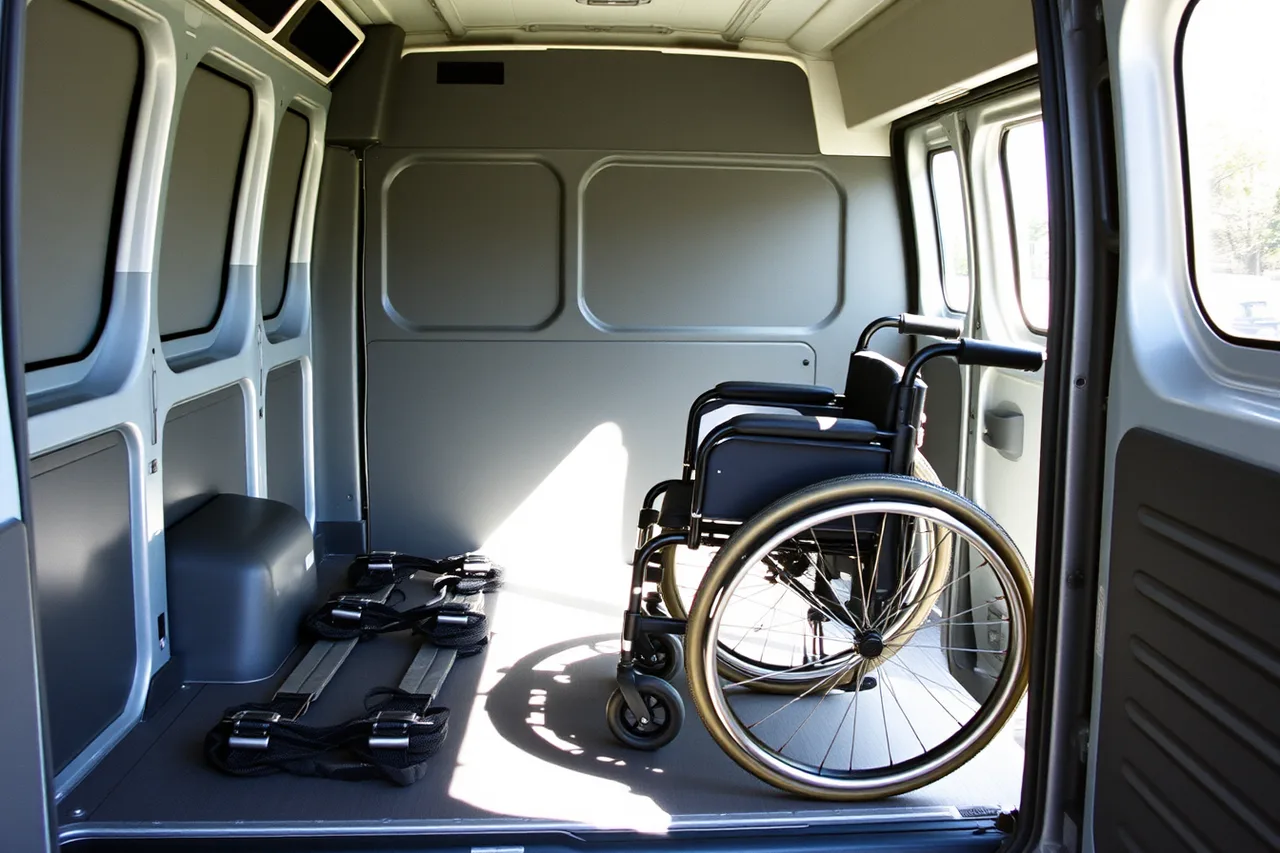
The load is a sequence: arrive, find the passenger, get them to the vehicle. Then board, secure, confirm. Each step can go wrong in a way a driver can prepare for.
The securement step should follow the instructions of the people who made the tie-down system, the conversion and the wheelchair. Keep those instructions in the vehicle to consult, not to remember.
One standard that is often cited here and does not apply: the federal cargo securement rules govern freight restraint on commercial vehicles. A passenger is not freight, and a practice justified by analogy to those rules has not been justified.
Write down what a driver does when the passenger's actual situation differs from the booking, or when they decline to travel. A passenger may refuse a trip, and that is their decision. The driver's job is to record it, notify, and leave safely, not to persuade.
Stage four: close-out
The trip is not finished when the passenger is delivered. It is finished when the record exists.
Whatever your payer requires, capture it at the point of delivery rather than at the end of the shift. Times at both ends, mileage, the assistance level actually delivered, the confirmation or signature, and any exception that occurred. A record written from memory four hours later is a record that will disagree with somebody else's memory.
The general expectation: a business keeps documents supporting what it billed. See the Internal Revenue Service guidance on business records.
Trip-level requirements are stricter. Your program and contract set them, and they vary by state. That is the point of the Centers for Medicare and Medicaid Services description of how the benefit is administered. Establish yours from sources mapped in the licensing and compliance guide.
Stage five: exceptions, which are most of the work
Design a path for each of these before it happens. A written path takes ten minutes to produce and saves an hour each time it is used.
Pre-made exception paths
Passenger not ready? Yes -> hold, call, then no-show
Passenger declines to travel? Yes -> record, notify, leave
Access does not match booking? Yes -> attempt or abort, who authorizes
Stage five: exceptions
| Exception | The decision to pre-make |
|---|---|
| Passenger not ready | How long the driver holds, who is called, when it becomes a no-show |
| Passenger declines to travel | Record, notify the booking party, leave; never persuade |
| Access does not match the booking | Attempt or abort, who authorizes, what is recorded |
| Chair or equipment does not match what was booked | Do not improvise a securement; call the booking party |
| Vehicle failure with a passenger aboard | Who is called first, in what order, and where the passenger waits |
| Will-call that has not come by a stated time | Who chases, and at what point the vehicle is released |
| Appointment overruns at the far end | Who is told, and what happens to the trips behind it |
The middle two are the ones where a driver most needs a rule, because both feel like a judgment about the passenger and neither should be.
What the systems have to do
Whatever holds your work, it has to carry access notes forward from one trip to the next, tell a dispatcher which vehicle can take which chair, and produce the close-out record without a second data entry. That is a low bar, and many arrangements fail it.
Paper meets it for a single vehicle. Beyond that, the constraint is usually not the tool but whether the access notes are being kept current, which is a habit rather than a purchase.
Staffing the operation, not just the vehicles
Someone has to answer the phone during the day, chase will-calls and handle exceptions. In a one-vehicle operation that is the owner, and it does not scale: a driver cannot take an intake call while securing a passenger.
Plan the point at which dispatch becomes a role rather than a spare moment, and price it as a cost of the operation rather than as an overhead surprise. Wage levels by occupation and area can be looked up in the Bureau of Labor Statistics wage tables as a starting point for that budgeting.
Reviewing the operation weekly
Three questions, once a week, with the records in front of you.
Weekly review, records in hand
- Which trips ran late, and was the cause intake, access, load time or schedule
- Which exceptions happened, and did the written path get followed
- Which close-outs were incomplete, and why
Which trips ran late, and was the cause intake, access, load time or the schedule? Which exceptions happened, and did the written path get followed? Which close-outs were incomplete, and why?
Fix the process rather than the person, and change the intake questions when the same access surprise appears twice.
What the operation must deliver is in the guide to what a service consists of. Cost per hour to run is in the pricing and profit guide.
The vehicles and premises behind it are covered in the fleet and premises guide. How all of it fits the wider sequence of starting up is in the owner's guide to this trade.
Common questions
How much detail should an access note carry?
Enough that a driver who has never been there arrives at the right door. Entrance, floor, steps, gate codes where you are permitted to hold them, and who to ask for.
What if a facility keeps giving us wrong pickup information?
Record it each time, then show them the pattern at a review meeting. A facility rarely knows how much time its own process is costing, and evidence changes the conversation.
Should drivers make routing decisions themselves?
They should be able to deviate for traffic and to sequence within a trip. What they should not carry alone is the decision to abandon or attempt a difficult trip, which belongs to whoever can call the booking party.
How do we handle a passenger who is regularly not ready?
As a scheduling fact rather than a complaint. Adjust the allowance for that pickup, tell the booking party what you have done, and stop planning the trip optimistically.