Guides
What a NEMT daily SOP needs to cover, from pre-shift checks to will-call
A daily NEMT procedure in the order the day happens: pre-shift checks, the pickup sequence, transit, drop-off, will-call returns, and when to stop.
What to take away
- A daily procedure is only useful if it has stop conditions. Every step below says what makes the day pause, because that is the part a checklist normally leaves out.
- Write it for the worst morning, not the ordinary one. On an ordinary morning nobody needs it.
- The stop conditions protect the passenger first and the business second. A driver should never have to invent one at a doorway.
- One page, in the vehicle, in the order the day happens. A manual nobody opens is not a procedure.
- What your own program requires in each of these steps comes from your state Medicaid agency, its broker and your contract. Confirm rather than assume.
Procedures fail for a predictable reason: they list what to do and say nothing about when to stop. So the driver, standing in the rain with a chair that does not match the booking, does the thing that seems most helpful. This version puts the stop conditions in.
Before the shift
- Vehicle checkedfuel or charge, tires, lights, cleanliness inside
- Accessibility equipment cycled through its full travel, ramp or lift, under power where applicable
- Securement system complete, undamaged, with the spare set aboard
- Equipment instructions present in the vehicle where they can be read
- Phone charged and mounted, charger present
- Day's assignments received, with access notes and appointment times attached
- Any known exception for today acknowledgeda difficult access, a new passenger, a will-call window
Stop condition: if the accessibility equipment does not complete a full cycle, the vehicle does not carry a passenger who needs it. Report it and the day is re-planned around the fault, not through it.
Pre-shift NEMT vehicle checks
- Fuel or charge, tires, lights, cleanliness
- Accessibility equipment full cycle under power
- Securement system complete with spare set
- Equipment instructions readable in vehicle
- Phone charged and mounted, charger present
- Assignments with access notes and times
- Known exceptions acknowledged for today
At the pickup
- Arrive at the pickup point named in the notes, not merely at the address.
- Identify the passenger and confirm the destination and appointment time with them.
- Check that the mode and the chair match what was booked.
- Assist at the level that was agreed, and no further without authorization.
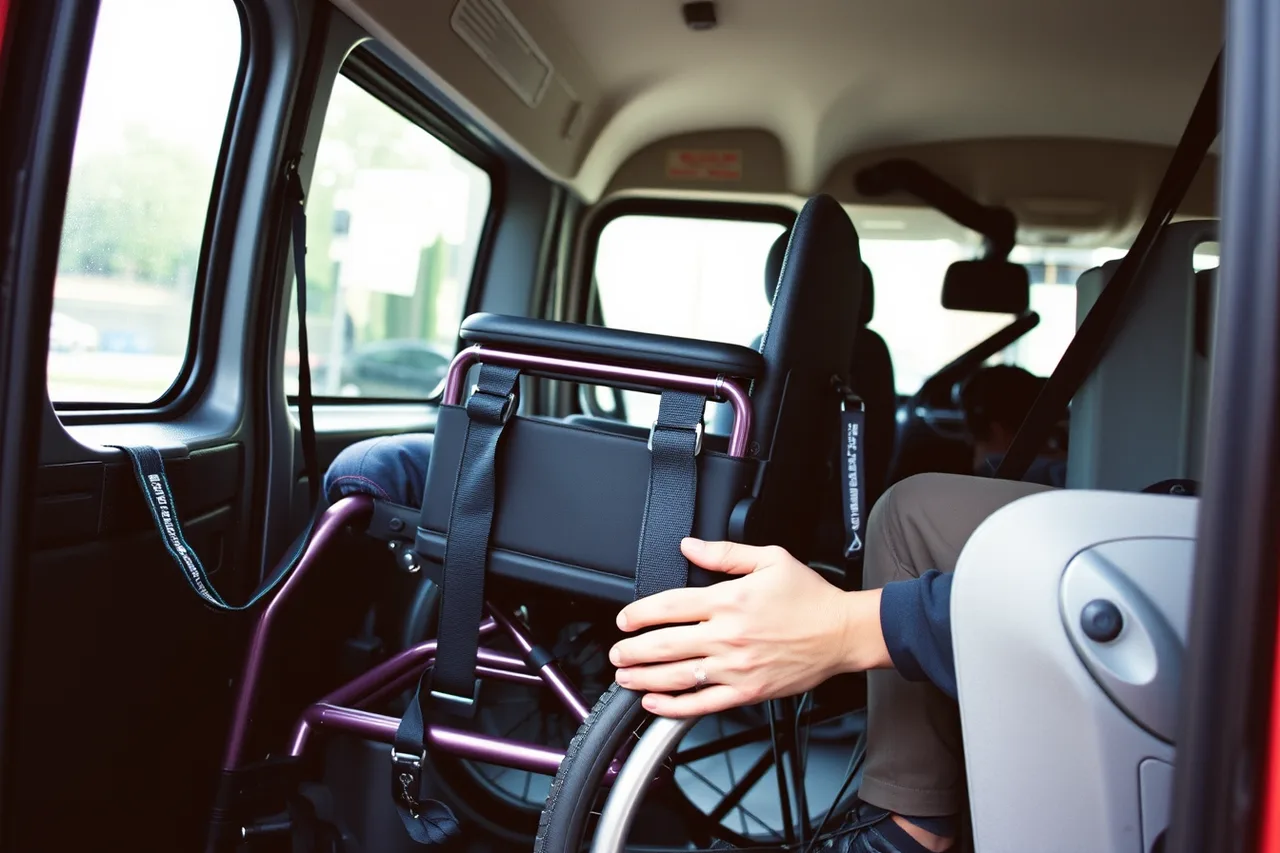
- Secure the passenger following the instructions of the tie-down, conversion and wheelchair manufacturers.
- Confirm the passenger is comfortable and record the departure time.
Stop condition at step three: if the chair or the passenger's needs do not match the booking, do not improvise. Call the booking party and record the outcome. A securement that is not covered by the manufacturers' instructions is not a securement.
Pickup sequence and stop points
- Arrive at named pickup point, not address
- Confirm passenger, destination and appointment time
- Match mode and chair to booking
- Assist only at agreed level
- Secure per manufacturer instructions
- Confirm comfort and record departure time
Stop condition at step four: if the assistance required exceeds what was agreed, or would mean attempting stairs or a lift that your written rule does not allow alone, call rather than attempt.
Stop condition at any point: if the passenger declines to travel, that is their decision. Record it, notify the booking party, leave courteously. Never persuade.
In transit
Keep to the sequencing the schedule assumed, and report a delay when it happens rather than when it becomes visible. A dispatcher who learns about a ten-minute delay at the time can move the trip behind it; one who learns at the destination cannot.
Delay reporting timing
- Delay occurs
- Report immediately to dispatcher
- Dispatcher moves trip behind it
- Late report cannot be fixed
Stop condition: any incident, however minor, follows the incident procedure before anything else. That procedure should name who is called first and in what order, and it should be short enough to remember.
At the destination
- Deliver the passenger at the agreed level of assistance.
- Where the agreement names a receiving person, hand over to them and record who it was.
- Capture the required confirmation or signature at the point of delivery.
- Record the arrival time, the mileage and any exception.
Stop condition at step two: if the named receiver is not available, do not leave the passenger unattended. Contact the booking party and wait for an instruction.
Destination handover steps
- Deliver at agreed assistance level
- Hand over to named receiver and record
- Capture confirmation or signature
- Record arrival time, mileage, exceptions
The record you produce here is the one that gets you paid, and rebuilding it later is where disputes start. The Internal Revenue Service says keeping documents that support what was billed is the general expectation.
Your state program sets what a trip record must contain for your payer. The Centers for Medicare and Medicaid Services page on the benefit explains that this is arranged state by state. Establishing yours is covered in the licensing and compliance guide.
Will-call returns
Confirm at drop-off who will call, on what number, and roughly when. Record the window.
Stop condition: if the call has not come by the time recorded in your own procedure, the person named in that procedure chases it. The vehicle is not released for other work until somebody has decided to release it, and that decision is logged.
Between trips
Reset the vehicle: clean anything that needs cleaning, stow the equipment properly, restock what was used. This takes minutes and is the difference between a vehicle that is ready and one that is nearly ready.
Report anything that consumed more time than planned. That is data, not a complaint, and it is how load-time allowances get corrected rather than argued about.
End of shift
- All trip records complete and submitted, with no gaps to be filled from memory
- Exceptions written up while they are fresh
- Equipment charged for the morning, including the lift battery
- Faults reported through the named channel, not mentioned in passing
- Vehicle secured, keys where the rule says they live
- Fuel or charge left at the level your procedure sets for the next shift
Stop condition: a fault mentioned to a colleague is not a fault reported. If it is not in the channel, the morning shift will find it.
Keeping the procedure honest
Review it monthly against what actually happened. Where drivers routinely depart from a step, either the step is wrong or the training is, and both are yours to fix rather than theirs.
The wider design this sits inside is in the operations and workflow guide. The competencies behind it belong with the hiring and training material, and the equipment assumptions come from the fleet and premises guide. What you promised an account is set out in whatever scope you agreed, which is the subject of the sales and proposal guide.
One reference that does not belong in a securement step, despite being commonly quoted: the federal cargo securement rules cover freight, not passengers.
Common questions
How long should the daily procedure be?
One page that a driver can hold. Anything longer belongs in training, not in the vehicle.
Who is allowed to override a stop condition?
Name a person, not a role, and make sure they are reachable during operating hours. An override with nobody to authorize it is a driver deciding alone.
Should the procedure differ by vehicle?
The equipment steps will, because a lift and a ramp are different machines. Keep the structure identical so that a driver moving between vehicles is not learning a new document.
What if a passenger asks for something outside the agreed assistance level?
Explain plainly that you need to check, and call. Most requests are reasonable and most can be agreed; what causes harm is agreeing on the spot to something the vehicle, the equipment or the insurance does not cover.