

Guides
8 things to understand about nemt hiring and training
NEMT hiring built around a role that is driver, lifter, reassurer and record keeper at once, with training signed off on observation rather than attendance.
What to take away
The eight things this NEMT hiring guide covers, in order: 1) define the role before you advertise, 2) what the pay has to cover, 3) where to find people, 4) selecting, 5) training on the equipment you own, 6) signing off on what you observed, 7) the stop conditions that carry the real judgment, and 8) retention.
- The driver is also the lifter, the reassurer and the record keeper. Design the role around all four or you will hire for the one that is easiest to describe.
- Two of those four are the hard part. Plenty of people can drive a van; fewer can manage a difficult doorway and a frightened passenger in the same five minutes.
- Turnover is the largest hidden cost in this trade, because a new driver is slower at every load for weeks and slower at difficult buildings for months.
- Train on the equipment you actually own, with the chairs you actually carry, and sign off on observation rather than attendance.
- Employment obligations come from the Department of Labor and the Equal Employment Opportunity Commission; background checks from the Fair Credit Reporting Act and, for Medicaid-funded trips, the HHS Office of Inspector General's List of Excluded Individuals and Entities; driver criteria from your state licensing agency, your Medicaid program or its broker, and your insurer.
Job advertisements in this trade usually describe driving. The work is mostly not driving. It is arriving at an unfamiliar building, finding a person who may be unwell or anxious, moving them safely across a threshold that was not designed for it, and doing that fifteen times before lunch while a schedule runs.
Hire for that and the operation works. Hire for the driving and you will spend a year wondering why load times never improve.
1. Define the role properly before you advertise
Write the role as four jobs held by one person.
Four Jobs, One Person
Driving
- What it involves
- Safe operation, punctuality
- What to select for
- Record, not enthusiasm
Physical assistance
- What it involves
- Ramps, transfers, doorways
- What to select for
- Honest repeated ability
Interaction
- What it involves
- Unwell or anxious passengers
- What to select for
- Patience under time pressure
Records
- What it involves
- Times, mileage, exceptions
- What to select for
- Whether they finish things
Define the role properly
| Component | What it actually involves | What to select for |
|---|---|---|
| Driving | Safe operation, local knowledge, punctuality against an appointment | Record, not enthusiasm |
| Physical assistance | Ramps, transfers, awkward doorways, weather | Honest assessment of what they can do repeatedly, not once |
| Interaction | Passengers who are unwell, anxious, or having a bad day | Evidence of patience under time pressure |
| Records | Times, mileage, confirmations, exceptions, captured at the door | Whether they finish things |
An advertisement that lists all four attracts fewer applicants and better ones. It also prevents the conversation, six weeks in, where somebody says nobody told them about the lifting.
2. What the pay has to cover
There is no national figure for what a driver in your county will accept for a role that includes all four components. What exists is published wage data by occupation and metropolitan area, from the Bureau of Labor Statistics' Occupational Employment and Wage Statistics (OEWS) survey, which is the right resolution to start with and not an answer in itself.
From Wage Data to Pay Offer
- Start with BLS occupational wage tables
- Use data as a floor, not an answer
- Ask candidates what they will accept
- Check whether wait time is compensable
- Consult DOL small business compliance
The answer comes from candidates. What the data gives you is a floor for the conversation and a check on whether your assumption is far from the local market.
Two features complicate pay in this trade. Appointment patterns cluster at the start and end of the day, so the middle often looks unpaid.
Wait time is real time: a driver holding for a will-call return is not free. Whether that time is compensable is a question under the Fair Labor Standards Act, and it turns on the facts of the arrangement. Start with the Department of Labor's compliance assistance for small businesses before taking advice on your own arrangements.
3. Where to find people
The candidates who last tend to come from adjacent work rather than from driving jobs: care settings, hospital portering, community transport, anywhere the person has already learned that a schedule and a vulnerable person are both real constraints.
Referral from existing drivers is the highest-yield channel in most small operations, and it is worth paying for. One risk deserves naming: recruiting only through referral tends to reproduce the group you already have.
Beyond those two channels, the ones that reliably produce applicants in this trade are state vocational rehabilitation agencies, American Job Centers, community college driver training programs, transit and paratransit agencies, and community and faith organizations that already serve the passengers you carry.
Selection has to be based on the requirements of the job. The EEOC's resources for small businesses explain where the obligations sit and where to get help understanding them.
4. Selecting
Whatever the process, keep three things constant.
Ask every candidate the same core questions, so that you are comparing answers rather than impressions. Base the decision on the requirements you wrote down in the role definition. And check what you are permitted and required to check: a motor vehicle record, a criminal background check that may be fingerprint-based, and, where Medicaid or Medicare funds the trips, a match against the HHS Office of Inspector General's List of Excluded Individuals and Entities.
Write the questions down before the first interview. A set of questions invented in the room measures how the conversation went, not how the candidate compares.
Background checks run through a third-party consumer reporting agency fall under the Fair Credit Reporting Act, which gives the candidate rights over the report and requires an adverse-action notice if you decline on the basis of what it shows. Your state program, your broker and your insurer each set requirements on top of that, so ask all three directly rather than working from a template.
5. Training on the equipment you own
General training is close to useless here. A driver trained on a ramp who is given a lift is untrained, and a driver trained on one securement system who meets another is improvising.
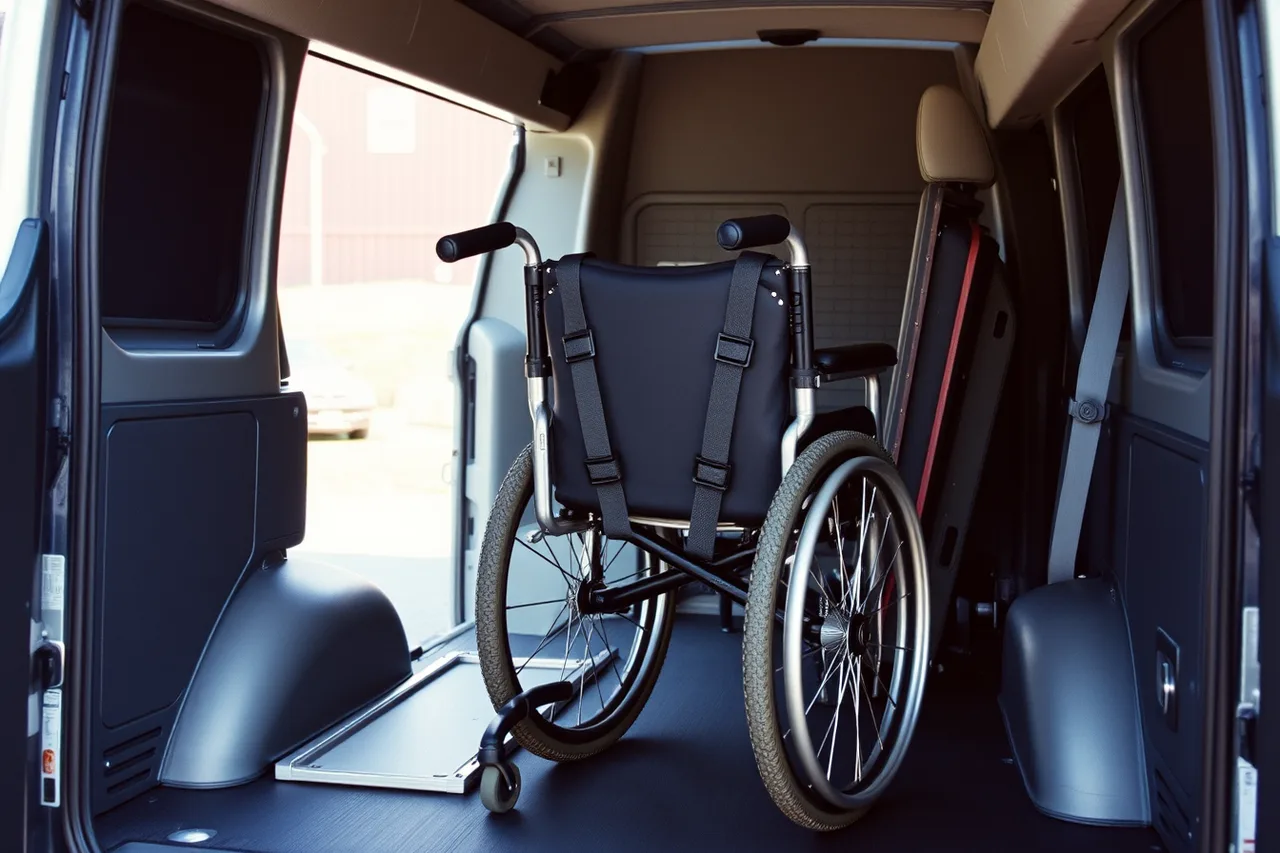
Train on the exact vehicles and equipment in your fleet, and on the chairs you actually carry, following the instructions issued by the manufacturers of the tie-down system, the conversion and the wheelchair. Keep those instructions in the vehicle. The equipment itself carries standards worth knowing: WC19 for wheelchairs designed to be used as seats in motor vehicles, and SAE J2249 for the tie-down and occupant restraint systems that hold them. Where a chair is unusual, the training is specific to that chair.
One document to keep out of the training room: the Federal Motor Carrier Safety Administration's cargo securement rules. They govern freight restraint on commercial vehicles, a passenger is not freight, and teaching a securement practice by analogy from a cargo rule teaches something nobody has approved.
The equipment those procedures attach to is covered in the fleet and premises guide.
6. Sign off on what you observed
Attendance at training proves nothing. Sign off on demonstrated competence, by watching.
Observed Competence Sign-Off
- Watch the person do it under realistic conditions
- Record who watched, when and what they saw
- Redo observation when equipment changes
- Redo when person moves to a different vehicle
- Redo periodically for high-risk tasks
For each competency, watch the person do it under realistic conditions, and record who watched, when and what they saw. Redo the observation when the equipment changes, when the person moves to a different vehicle, and periodically for the tasks where getting it wrong hurts somebody.
Keep the competency list short enough that every item is actually observed. A list nobody has time to watch becomes a list somebody ticks.
7. The part of training nobody writes down
New drivers get the mechanics quickly and the judgment slowly. Judgment here means knowing when to stop.
When to Stop and Call
Chair does not match the booking?
Call dispatch, do not attempt
Proceed with the trip
Teach the stop conditions explicitly: when a chair does not match the booking, when the assistance needed exceeds what was agreed, when a passenger declines to travel, when an access route is not safe. Each of those should end with a phone call rather than an attempt, and a driver should never feel that calling counts against them.
Say plainly that a passenger may refuse a trip and that the driver's role is to record and notify, never to persuade. And that a driver is not there to judge whether somebody is well enough to travel. That is not their decision, and it is not yours: it belongs to the people responsible for the passenger's care.
These paths belong in the written procedure, which is the subject of the operations and workflow guide.
8. Retention is cheaper than recruitment
A new driver is slower at every load for weeks, does not know the buildings, and costs you punctuality on exactly the standing orders where lateness is expensive. That cost never appears as a recruitment line and is larger than one.
What keeps people, in most small operations, is predictable hours, equipment that works, being told about problems in advance, and not being blamed for a load time that was always wrong. Pay matters and is rarely the first thing that goes wrong.
Staffing cost is the largest input to what you charge, and that arithmetic is in the pricing and profit guide. The service promises your crew must keep are defined in the guide to what a service consists of.
The credentials and checks your program requires are mapped in the licensing and compliance guide. How staffing fits the wider startup sequence is in the owner's guide to this trade.
Common questions
Should I hire drivers as employees or contractors?
Should I hire drivers as employees or contractors? That classification is a legal question with real consequences, and it depends on the facts of the arrangement rather than on what the paperwork says. The IRS publishes Form SS-8 for a formal determination of worker status, and the Department of Labor's Wage and Hour Division publishes guidance on the same question. Take advice on your own situation.
What credentials should a driver hold?
What credentials should a driver hold? The categories to ask about are a state driver's license of the class your vehicles require, a clean motor vehicle record, a criminal background check that may be fingerprint-based, a match against the HHS Office of Inspector General's List of Excluded Individuals and Entities, CPR and first aid, defensive driving, and passenger assistance and wheelchair securement training such as the PASS certification from the Community Transportation Association of America. Which of them you must have, and in what form, is set by your state Medicaid NEMT program, the broker that runs the trips (Modivcare and MTM are common examples), your contracts and your insurer, so ask each of them directly rather than adopting a list from elsewhere.
How long before a new driver is fully productive?
Longer than most owners plan for, because building familiarity means knowing entrances, elevators and individual passengers. Plan the schedule around a slower first month rather than discovering it.
Can I train drivers myself?
You can train on procedure and on your own equipment if you genuinely know it. Equipment-specific training from the supplier is worth having at least once, so that what you teach afterward matches what the manufacturer intended.