
Guides
Reliable NEMT hiring: interview, practical test, references
A three-stage selection day for NEMT driver hiring: five fixed interview questions, a practical test on your own ramp, three reference questions, one scorecard.
What to take away
- Run every candidate through the same three stages in the same order: interview, practical test, references. Comparison needs a constant.
- The useful interview questions are about specific past situations, not hypothetical ones. Anyone can describe how they would handle an anxious passenger.
- The practical stage is twenty minutes on your own vehicle. Watch the candidate approach it, deploy the ramp after one demonstration, and talk to somebody sitting in a chair.
- Whether the trip record gets finished in the practical stage predicts your close-out rate better than anything a candidate says in interview.
- Write the result of each stage on one scorecard, so the decision rests on what you saw rather than on how the day felt.
- What you may ask, what you must check, and how you must treat the answers are set by law and by your program, broker and insurer. Take advice; nothing here is a legal instruction.
One protocol for every candidate
Use the same three stages for every candidate, in the same order, and write down what you see. An interview that wanders measures the conversation rather than the person, and a hire made from a wandering interview is a guess you will pay for in week three.
Reliability in this trade is not mostly about driving skill. It is about turning up, staying calm at a difficult doorway, and finishing the record before moving on. Those are observable, and most hiring processes fail to observe them. Each stage below is built to observe one of them.
Stage 1: the five interview questions
Ask these of everyone, in this order, and write down what you hear. Each question asks for a specific past situation, so the answer is evidence rather than a promise.
Five Constant Interview Questions
- Fixed-time jobwhat made it hard?
- Helped someone frightened or in pain?
- Could not complete task as told?
- Most physically demanding work, days per week?
- What would make you leave within six months?
- Tell me about a job where you had to be somewhere at a fixed time every day. What made that hard, and what did you do about it?
- Describe a time you helped somebody who was frightened or in pain. What did you actually say?
- Tell me about a time you could not complete a task the way you were told to. What did you do?
- Describe the most physically demanding work you have done, and how many days a week you did it.
- What would make you leave a job like this within six months?
Question three is the most informative. You are listening for whether the person escalated or improvised. In this trade the correct answer is usually to stop and call, and a candidate whose instinct is to solve it alone needs to know that before they start rather than after.
Question five is answered honestly more often than owners expect, and the answer is a list of the things you have to get right to keep them. Skip hypotheticals and skip anything answerable with a value statement, including whether they are comfortable with lifting. The practical stage answers that one.
Stage 2: the practical test on your own vehicle
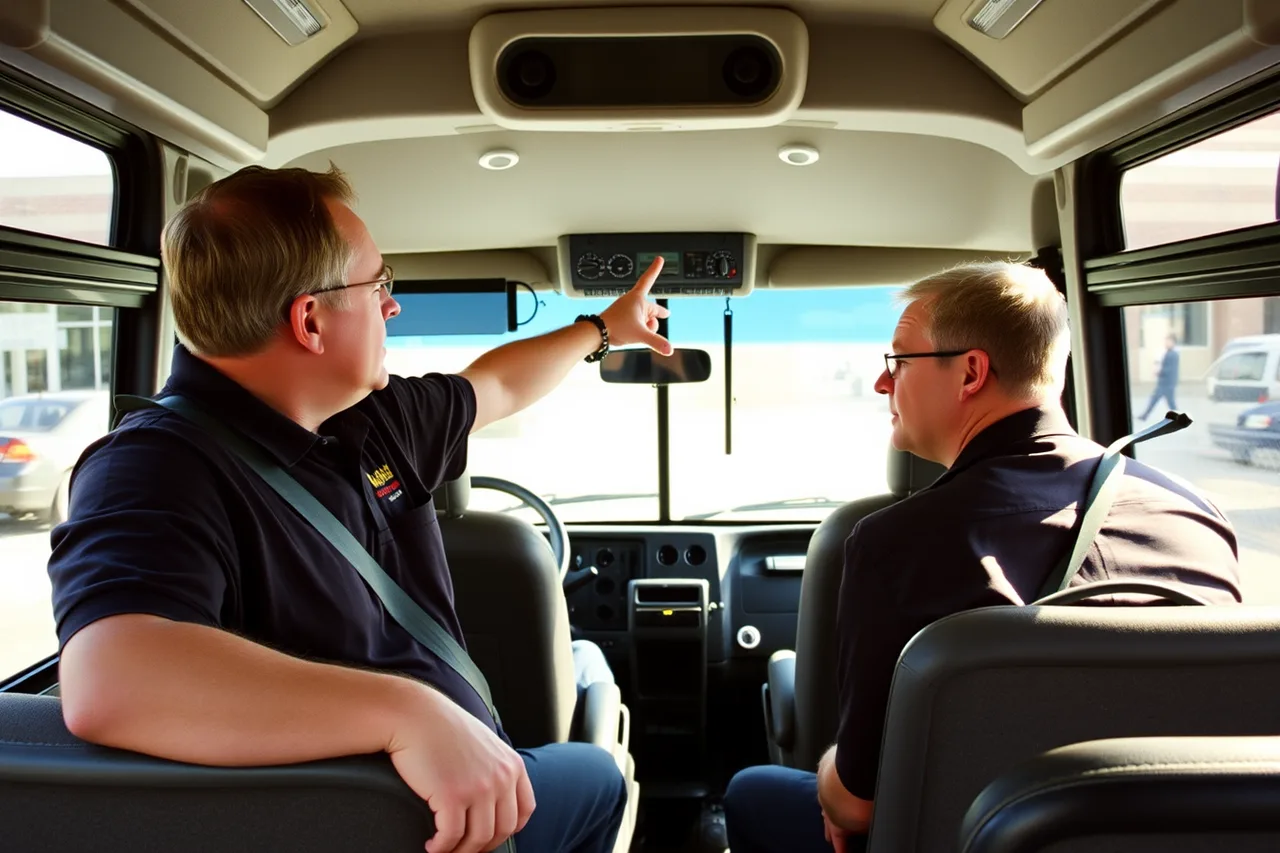
Run twenty minutes on your own vehicle, with a colleague in a wheelchair. Show the candidate the ramp or lift once, then ask them to do it. The point is to see how they behave, not what they already know.

Watch whether they read the situation before acting, whether they check with the person in the chair, and whether they ask when unsure. You are not testing whether they know your equipment. You are testing how they behave when they do not.
Then ask them to complete a short trip record from the exercise. Whether it gets finished, and finished legibly, predicts a great deal about your close-out rate.
What to watch for in the practical test
What to watch for
| What they do | What it suggests |
|---|---|
| Looks at the slope and the doorway before touching anything | Reads a situation; the load times will be safer and often faster |
| Speaks to the person in the chair before moving them | The interaction half of the job is already there |
| Asks when unsure rather than guessing | Will use the stop conditions instead of improvising |
| Rushes to finish because you are watching | Coachable, but tell them explicitly that speed is not what you are measuring |
| Finishes the record without being reminded | Predicts your close-out rate better than anything they say in interview |
None of these disqualify anyone on their own. Together they describe how the person will behave at a door when nobody is watching.
What to Watch in the Practical Stage
What they do
- Slope and doorway
- Looks before touching
- Person in chair
- Speaks before moving
- When unsure
- Asks rather than guesses
- Being watched
- Rushes to finish
- Trip record
- Finishes without reminder
What it suggests
- Slope and doorway
- Safer, often faster load times
- Person in chair
- Interaction half already there
- When unsure
- Will use stop conditions
- Being watched
- Coachable; say speed is not measured
- Trip record
- Predicts close-out rate
Stage 3: two reference calls
Make two calls of about five minutes each, and ask the same three questions on both. A reference given in a free-flowing chat is easy to charm; the same three questions give you answers you can compare between candidates.
Three Reference Questions
- How was their attendance, including short notice absence?
- Describe a day that went badly for them and what they did.
- Would you take them back?
- How many days was this person absent or late in the last six months, and how many of those were unplanned?
- Tell me about a time this person had a bad day at work. What did they do?
- Would you rehire this person? Why, or why not?
Then stop talking. The pause after the third question is where most of the useful information arrives.
Putting the three stages on one scorecard
| Stage | What to write down | The line to circle |
|---|---|---|
| Interview | The answer to question three, in the candidate's words | Escalated, or improvised |
| Practical test | Which behaviors in the table you saw | Asked when unsure, or guessed |
| Practical test | Whether the trip record was finished and legible | Finished unprompted, or not |
| References | Absences and lateness, the bad-day story, and the rehire answer | Would rehire, or hesitated |
Fill the card in before you compare candidates, not after. Reading three scorecards side by side shows the pattern that an afternoon of conversation hides, and it gives you something concrete to tell a candidate you do not hire.
What you may ask, and where pay fits
Background and driving record checks in this work are shaped by your state program, your broker contract and your insurer, and they differ. Establish what is required before you build the process.
Do not adopt a checklist from another state. The map of who sets what is in the licensing and compliance guide.
Base selection on the job's requirements. The EEOC's Small Business Resource Center has answers to common questions about your responsibilities under the federal employment discrimination laws, and it is a sensible place to check your question list before the first interview.
Prepare the pay side of the conversation from published wage data. The Bureau of Labor Statistics OEWS wage program produces employment and wage estimates annually for approximately 830 occupations. Use those figures as a floor for the discussion rather than as an answer.
Say what the job is before you make the offer
Describe the day honestly: the early start, the physical work, the buildings without elevators, the passenger who cancels at the door, the record that has to be finished before moving on. Say what the hours actually look like, including any gap in the middle of the day.
An offer accepted after that conversation lasts. An offer accepted before it produces a resignation in week three, and a resignation in week three costs you punctuality on the standing orders where lateness is least affordable.
The first month decides retention
Pair a new driver with an experienced one on the difficult buildings, not the easy ones. Give them a schedule with realistic allowances rather than a full one.
Tell them explicitly that calling for help is expected, and then respond quickly the first time they do, because that is the moment the habit is set.
When records slip, the fix is usually in tooling, not people, covered in the finance and software guide. How roles are built, and how training is signed off, sits in the hiring and training guide. Measure your own first-90-day retention rather than borrowing anyone's average.
Common questions
How many candidates should I see?
Enough that you are choosing rather than accepting. If you are hiring the first person who applies, the advertisement or the pay is the problem, not the process. Put every candidate through all three stages, including the one you like best.
Should I hire someone with care experience but no professional driving background?
Often yes. The care instincts are harder to teach than the driving, and the driving is checkable, but confirm the driving criteria your insurer and program require before you decide.
Is a trial shift a good idea?
Only if it is arranged properly as paid work with the right cover in place, which is a question for your adviser and insurer. An informal trial with a passenger aboard is not an option.
What do I do about a driver who is good with passengers and slow at records?
Fix the record process first. If completing it at the door is genuinely difficult, that is a design fault; if it is not, make the expectation explicit and observe it rather than absorbing the gap yourself.