
Guides
Four gates for a new NEMT operation, from demand to handoff
How to start an NEMT business as four gates: name the demand, list every authority (Louisiana as a worked example), dry-run the routes, hand off a day.
What to take away
- Treat the opening as four gates rather than a launch date. Each gate has an exit condition you can state out loud, and money spent before the gate opens is usually wasted.
- The dry run is the cheapest test you will ever get. Drive the routes, deploy the ramp, time the doorways, with a colleague in the chair instead of a patient.
- Your first account should be one that repeats. A standing order teaches you the operation faster than twenty scattered trips.
- Write down what you will refuse. An operation that accepts every request in month one is discovering its limits in front of a patient.
- Every regulatory answer here belongs to your state Medicaid agency, the broker holding its contract, and your state transportation regulator. Louisiana's Medicaid provider requirements, used below as a worked example, show what those answers look like in practice.
A useful starting sequence is not a checklist of tasks. It is a series of points where you either know something or you do not, and where spending before you know is the classic way a new operation runs out of cash while looking busy.
Gate one: you can describe the demand in a sentence
The exit condition is that you can name the facilities, the trip pattern and the mode, without adjectives.
Schedulable vs. Vague Demand
Schedulable
- Facilities
- Two named clinics
- Trip pattern
- Dialysis returns
- Mode
- Wheelchair
- Timing
- Three afternoons weekly
- Usable
- Yes
Vague
- Facilities
- Unnamed seniors
- Trip pattern
- Medical transport
- Mode
- Unstated
- Timing
- Anytime
- Usable
- No
"Dialysis returns for two clinics on the north side, wheelchair, three afternoons a week" is a sentence you can schedule around. "Medical transport for seniors in the metro area" is not.
Get to the first kind by calling schedulers and discharge planners and asking one question: when a ride does not show, what do you do instead? The workaround they describe is the gap you would be filling.
The owner's overview of how this trade works sets out the wider decisions this gate feeds into.
Gate two: you know what you are allowed to do
The exit condition is a written list of every authority that has a say, with a name and a phone number beside each.
Authorities to List
- State Medicaid agency
- Transportation broker
- Passenger carrier licensing body
- City or county vehicle-for-hire regulator
- Name and phone number beside each
They do not coordinate, and none will volunteer that another exists. What the licensing side involves walks through how to build that list.
Start with the Centers for Medicare and Medicaid Services overview of the transportation benefit to learn how the public program works.
Before you make those calls, ask about your state, not the country. Louisiana shows how layered the answer can be. The Louisiana Department of Health's Medicaid medical transportation provider requirements say that for-profit providers must comply with all state laws and the regulations of any governing state agency, commission, or local entity to which they are subject as a condition of enrollment. The same manual lists automobile liability coverage of $25,000 for bodily injury per person, $50,000 per accident, and $25,000 for property damages, requires worker's compensation insurance as Louisiana law requires, and asks for an NEMT permit issued by the Jefferson Parish Emergency Management Office for each provider, driver, and vehicle that will operate in Jefferson Parish. Wheelchair vehicles must comply with all applicable Americans with Disabilities Act requirements, including restraints, tie-downs, lifts, and ramps.
That is one state agency, one insurer conversation and one local permit office for a single parish. Other states organize the benefit differently: Pennsylvania, for example, provides non-emergency transportation for Medical Assistance beneficiaries through its Medical Assistance Transportation Program (MATP), and in Philadelphia County through a state negotiated contract with a brokerage. Your gate-two list should have the same shape: the Medicaid agency or program, the broker if there is one, the insurance minimums, and any city, county or parish permit.
Gate three: you have driven it without a patient aboard
The exit condition is a completed dry run on real addresses.
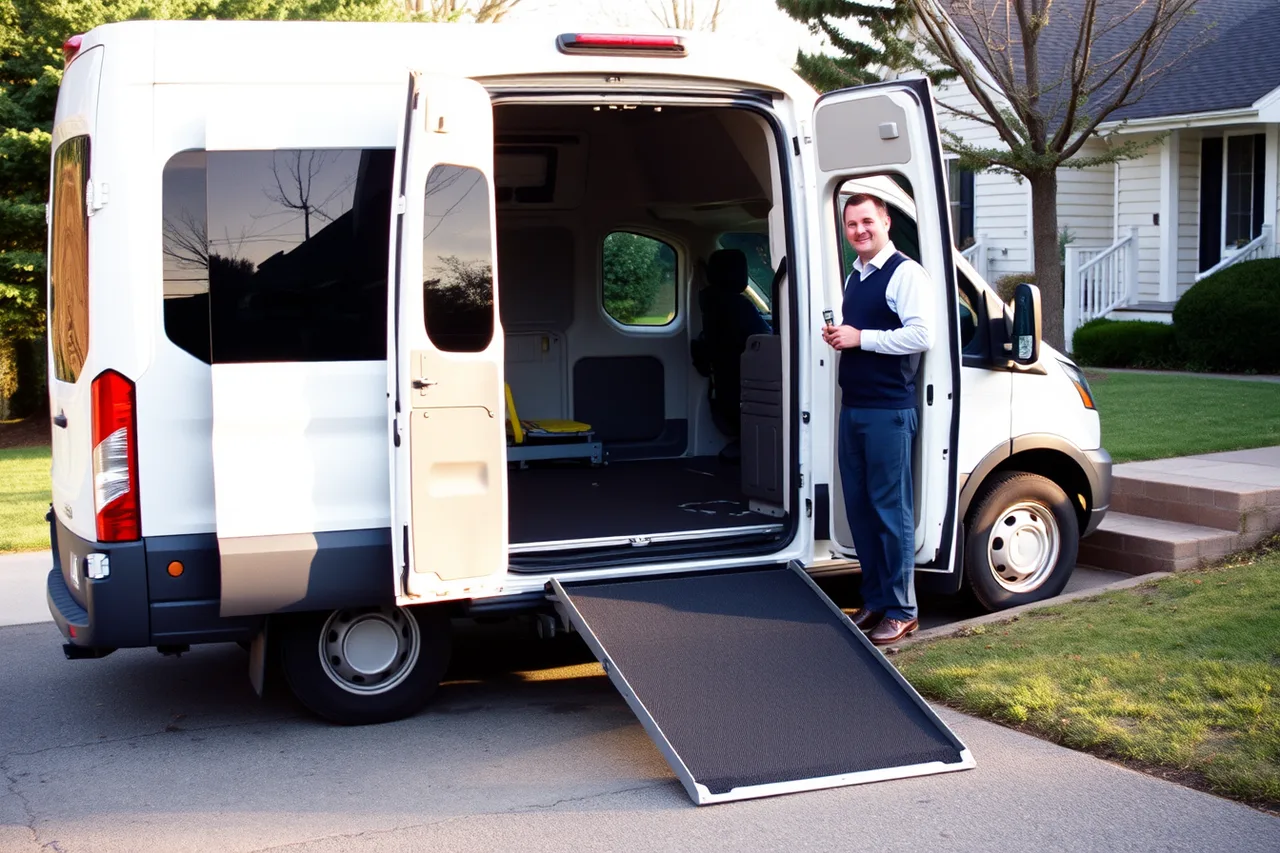
This is the step people skip, and it changes plans. Take the vehicle to actual pickup addresses on your target routes. Deploy the ramp on the actual slope. Time from the curb to a secured position in the vehicle.
Then time it again with a doorway that opens the wrong way. Drive from a plausible drop point to a plausible next pickup and note the time of the empty leg.
Three things usually come out of a dry run:
What the Dry Run Reveals
- Longerload time than planned
- At least oneaddress with an access problem
- Realunbillable gap between drop and next pickup
- The real curb-to-secured time, which is almost always longer than the time you planned per pickup.
- The addresses where the ramp, the slope or the doorway does not work for your vehicle, which go on the refusal list or need a different mode.
- The empty-leg minutes between a drop and the next pickup, which decide how many trips a vehicle can really do in a shift.
Fix the schedule to match what you measured. Do not plan to get faster. Choosing the vehicle and the base is much easier once you have those measurements in hand.
Gate four: somebody else can run a day without you
The exit condition is one full day of work delivered by a driver you hired, dispatched from your own process, with you watching rather than fixing.
Until that happens, you own a job.
Getting there needs a written intake, a trip handoff to a driver with access notes attached, and a close-out that records what happened.
Hiring and training the crew covers the people side; the finance and dispatch systems covers the records side.
What to spend at each gate
Reasonable to spend on
- One
- Phone calls, coffee, your own time
- Two
- Professional advice, filing fees, an insurance conversation
- Three
- A vehicle you could resell, fuel, a stopwatch
- Four
- Wages, dispatch tooling, training time
Wait until later for
- One
- Anything with a monthly fee
- Two
- Vehicles, signage, staff
- Three
- A second vehicle, a lease on premises
- Four
- Marketing at scale, expansion
The federal registration and tax steps run alongside all four rather than inside any one of them. The IRS guidance on starting a business and the Small Business Administration's planning material cover that side, which is the same for this trade as for any other.
Write down what you will refuse
Before the first booking, decide in writing which requests you will decline: modes you are not equipped for, distances outside your radius, times you cannot staff, and trips where the access description does not match your vehicle's capability.
Give the list to whoever answers the phone.
The alternative is discovering a limit at a doorway, with a patient waiting and a clinic slot running out. Refusing a booking is an ordinary business act. Failing a trip you accepted is not.
Common questions
How long do these four gates usually take?
There is no useful average, because gate two is where the variation lives and it is entirely a matter of which state you are in and how quickly its offices respond. Plan the sequence, not the calendar.
Can I run gates in parallel to save time?
Partly. Gate one and the ordinary registration work overlap fine. Gate three should not start before gate two closes, because the licensing answer can change which vehicle you buy.
What if I already own a suitable vehicle?
Then you have skipped a purchase, not a gate. Still do the dry run, and still confirm the vehicle meets whatever your state and your contract require before you carry anyone in it.
Should I sign with a broker before I have vehicles?
Signing a contract you cannot yet perform is the fastest way to lose the relationship. Talk to them early, tell them your timeline honestly, and sign when gate four is closed.